
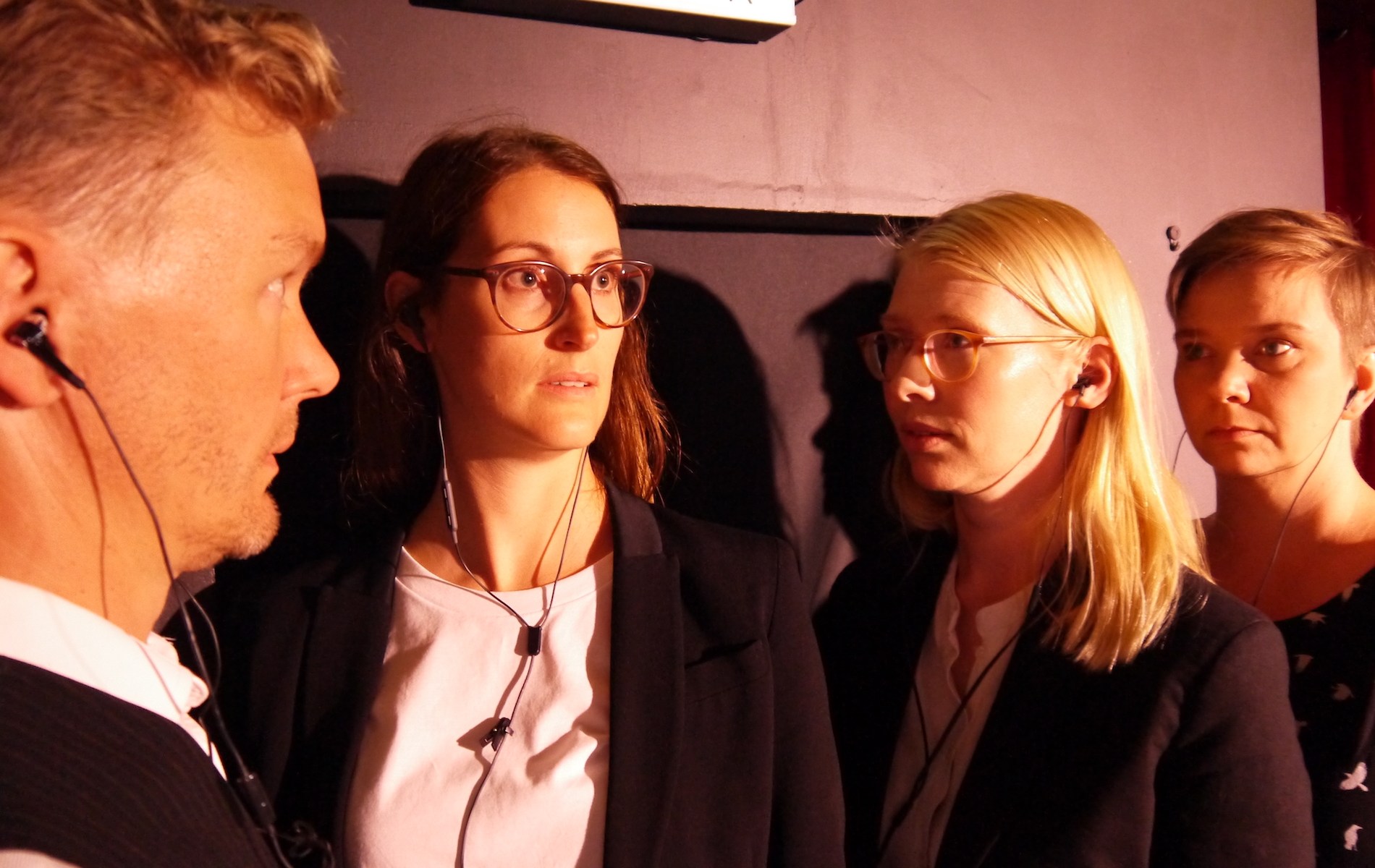
In addition to being an original improv comedy show, Improbotics is also the subject of scientific research on the use of artificial intelligence in theatre, which has been presented at international scientific conferences.
- Piotr Mirowski, Boyd Branch, Kory Mathewson (2025) “The Theater Stage as Laboratory: Review of Real-Time Comedy LLM Systems for Live Performance”, COLING Workshop on Computational Humor (CHum).
- Boyd Branch, Piotr Mirowski (2024) “Artificial Theatres of the Absurd”, in Will Slocombe & Genevieve Liveley, The Routledge Handbook of AI and Literature.
- Boyd Branch, Piotr Mirowski, Kory Mathewson, Sophia Ppali, Alexandra Covaci (2024) “Designing and Evaluating Dialogue LLMs for Co-Creative Improvised Theatre”, International Conference on Computational Creativity.
- Piotr Mirowski, Kory Mathewson, Boyd Branch (2023) “From Theatre to Computational Linguistics: Artist-in-the-Loop Artificial Intelligence”, Theatre About Science: Theory and Practice.
- Boyd Branch, Piotr Mirowski, Sophia Ppali, Rocio Von Jungenfeld, Paul Allain, Christos Efstratiou (2022) “Mirror Placement Matters in Remote Collaboration”, SIGCHI Conference on Human Factors in Computing Systems.
- Boyd Branch, Piotr Mirowski, Kory Mathewson (2021) “Collaborative Storytelling with Human Actors and AI Narrators”, International Conference on Computational Creativity.
-
Boyd Branch, Christos Efstratiou, Piotr Mirowski, Kory W Mathewson, Paul Allain (2021) “Tele-Immersive Improv: Effects of Immersive Visualisations on Rehearsing and Performing Theatre Online”, SIGCHI Conference on Human Factors in Computing Systems.
- Piotr Mirowski, Kory Mathewson, Boyd Branch, Thomas Winters, Ben Verhoeven (2020) “Rosetta Code: Improv in Any Language”, International Conference on Computational Creativity.
- Gunter Loesel, Piotr Mirowski, Kory Mathewson (2020) “Do Digital Agents Do Dada?”, International Conference on Computational Creativity.
- Piotr Mirowski, Kory Mathewson (2019) “Human Improvised Theatre Augmented with Artificial Intelligence”, AAAI Conference on Artificial Intelligence and Interactive Digital Entertainment, Atlanta.
- Kory Mathewson and Piotr Mirowski (2018) “Improbotics: Exploring Deception using Machine Intelligence in Improvised Theatre”, AAAI Conference on Artificial Intelligence and Interactive Digital Entertainment, Edmonton.
- Kory Mathewson and Piotr Mirowski (2017) “Improvised Comedy as a Turing Test“, Creative AI workshop at NIPS – Neural Information Processing Systems, Long Beach. That work featured in the New Scientist (Douglas Heaven, “Robot’s terrible jokes are a new test of machine intelligence”, 16 December 2017).
- Kory Mathewson and Piotr Mirowski (2017) “Improvised theatre alongside artificial intelligences“, AAAI Conference on Artificial Intelligence and Interactive Digital Entertainment, Snowbird.
Improbotics has also been the subject of a Master’s thesis in Social and Cultural Anthropology, published in: Ellen Smith (2022) “A posthuman performance: enacting the potentiality of artificial intelligence through relationality on stage“, Faculty of Social Sciences, KU Leuven.
Piotr and Kory, who are both improvisers and researchers in AI, believe in an interdisciplinary approach to the arts and sciences, and have created a community of like-minded artists, researchers, drama lecturers and science communicators including Boyd Branch, Sarah Davies, Jenny Elfving, Ben Verhoeven, Jutta Diessl, Thomas Winters or collaborator Gunter Loesel. Our vision is to explore new forms of human theatre through the help of state-of-the-art research in artificial intelligence and robotics, and to highlight what is uniquely human. For us, the skill of theatrical improvisation is one of the highest forms of human intelligence, and by confronting humans to the incongruity of machines on the stage, we can create new opportunities for comedy.
* To pass the Turing test, a machine (such as an artificial intelligence-based chatbot) needs to display the appearance of human-level intelligence by fooling a human judge into thinking that it is human.
Technology
At the heart of our improv show is the piece of technology that Piotr Mirowski and Kory Mathewson have developed over the years, initially as part of HumanMachine, and consisting in an artificial intelligence-based chatbot, called A.L.Ex.
A.L.Ex, which stands for Artificial Language Experiment (and is also an obscure reference to the clever parrot), is a computer system that can do speech recognition, improvised dialogue and voice synthesis. It is powered by neural network software. The first version was trained on OpenSubtitles (movie dialogue from a hundred thousand movies). We then switched to GPT-2, then GPT-3, then all possible flavours of Large Language Models, including Google’s Universal Sentence Encoder or open-source LLMs Llama and Gemma. We have been using various image generators, starting from DeepMind’s BigGAN to Stable Diffusion. Our theatre software is programmed by Piotr and Kory using open-source components. Despite being state-of-the-art, A.L.Ex is still a weak form of artificial intelligence.
At its core, A.L.Ex is a language model that captures the complex statistics of words. It is trained to produce the most obvious words that follow any context. It illustrates the fundamental principle of improv: always do the most obvious thing.
A.L.Ex runs on a laptop computer. A.L.Ex’s stage presence consists in microphone system for speech recognition, amplified sound and video projection using Touch Designer, and in two robots, produced by EZ-Robot and Aldebaran Nao, for which we developed custom control software. In the case of stage Improbotics shows, A.L.Ex controls human improvisers by sending them speech synthesized lines of dialogue via headsets, FM radios and augmented reality glasses.
 Improbotics